
Ingredients
Equipment
Method
- In a medium bowl, whisk together the warm water and whole psyllium husk. Let it sit for 2 to 5 minutes until it thickens into a gel-like consistency. 427 g warm water 15 g whole psyllium husk
- While the psyllium gel thickens, whisk together the tapioca starch, sorghum flour, brown rice flour, salt, instant yeast, and sugar in the bowl of a stand mixer or a large mixing bowl. 140 g tapioca starch 100 g sorghum flour 90 g brown rice flour 7 g instant yeast 12 g granulated sugar 8-10 g fine sea salt
- Whisk the olive oil and apple cider vinegar into the psyllium gel until fully combined. 15-18 g olive oil or avocado oil 3 g apple cider vinegar
- Pour the psyllium mixture into the dry ingredients.
- Mix with the paddle attachment (or dough hook) on medium speed for 4 to 5 minutes, until the dough is soft, sticky, smooth, and fully incorporated.
- Divide the dough into two equal portions and shape each into a dough ball.
- Place each dough ball on a sheet of parchment paper. Gently press it into a rough circle, then roll with a rolling pin into a 10 to 12-inch pizza crust, leaving the outer edge slightly thicker for the crust.
- If the dough sticks while rolling, place a second sheet of parchment paper over the top and continue rolling between the two sheets.
- Cover the shaped crusts with a clean kitchen towel and let them proof at room temperature for about 1 hour, or until slightly puffed.
- While the dough proofs, preheat the oven to 475°F (245°C) with a pizza stone, pizza steel, or upside-down baking sheet inside.
- Remove the top sheet of parchment paper, if using, and dock the center of each crust several times with a fork, leaving the outer edge untouched. (This means gently pierce the dough so it doesn't ballon up in the oven.)
- Carefully transfer the crust (still on the parchment paper) onto the hot pizza stone or baking sheet. Par-bake for 6 to 8 minutes, until the crust is set and just beginning to puff.
- Remove the crust from the oven, taking it off the parchment paper and resting it on a wire cooling rack. Then add your favorite toppings, for example pizza sauce, cheese, and etc.
- Return the pizza to the oven and bake for an additional 7 to 10 minutes, or until the cheese is melted and bubbly and the crust is golden brown around the edges.
- Note: if you have a lot of toppings, turn the heat down to 450 degrees (230°C) so the crust doesn't burn while your toppings bake and the cheese melts.)
- Let the pizza cool on a wire cooling rack for 5 minutes before slicing and serving.
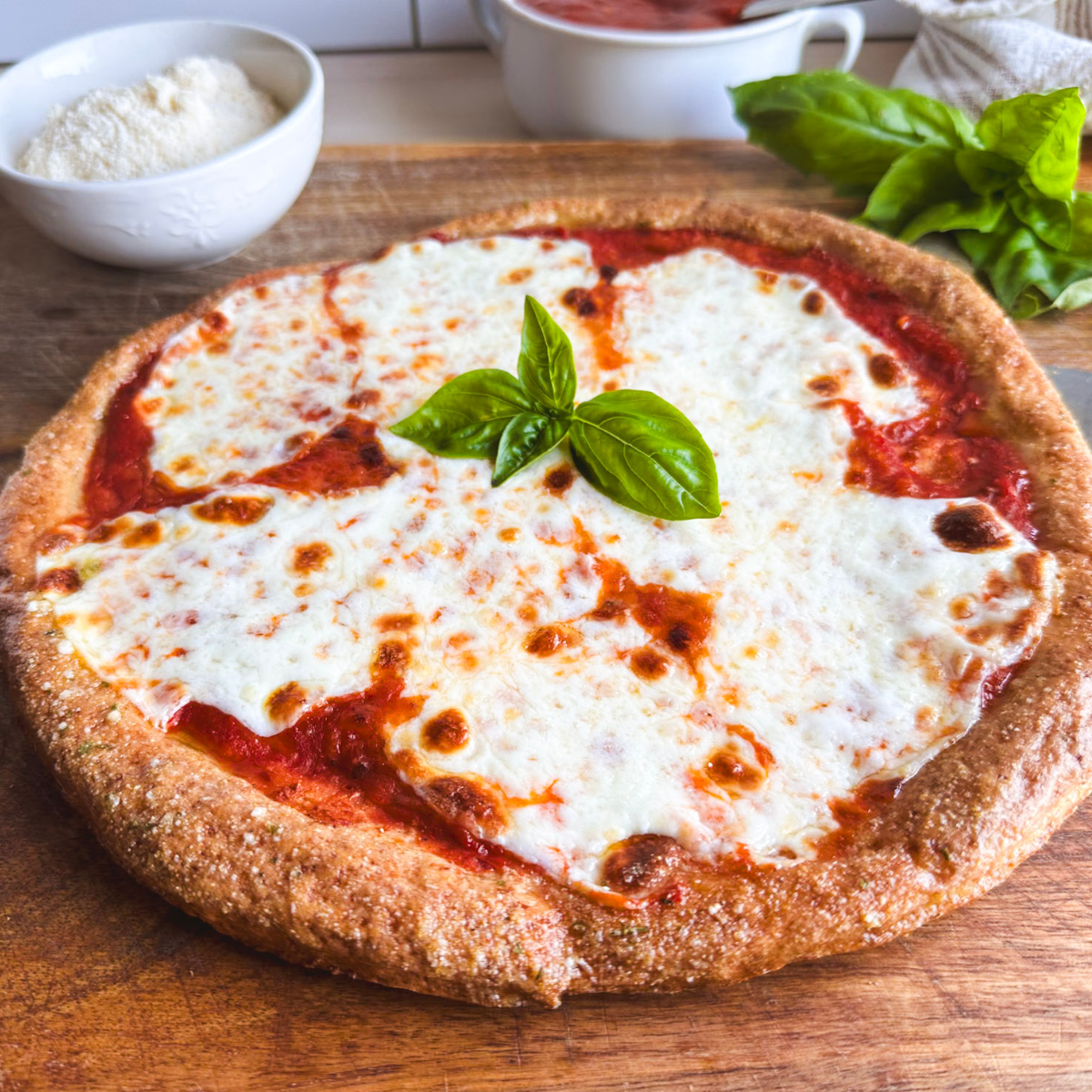
- Optional Garlic Parmesan Crust: While the pizza is still hot, whisk together the olive oil, Parmesan cheese, garlic powder, dried parsley, and a pinch of salt. Brush the mixture around the outer crust with a pastry brush before serving. 15 g olive oil 5 g finely grated Parmesan Cheese .5 g garlic powder .25-.5 g dried parsley pinch fine sea salt
Nutrition
Notes
Flour Blend Option: You can use a gluten-free flour blend as an alternative to the individual flours by substituting 330 grams total of flour. I have tested both King Arthur Measure for Measure and Bob's Red Mill 1-to-1 Baking Flour, and they both worked well. The dough will be stickier than the original recipe, so I recommend rolling it between two sheets of parchment paper. For the best flavor, texture, and easiest-to-handle dough, I still recommend making the recipe as written.
Use Whole Psyllium Husk: This recipe was developed using whole psyllium husk, not psyllium husk powder. Psyllium powder absorbs water differently and can change the texture of the dough.
Par-Bake for Meal Prep: To make pizza night even easier, par-bake the crust, let it cool completely, then refrigerate it for up to 3 days before adding your favorite toppings and finishing the bake.
Nutrition Information: The estimated nutrition facts include the optional Garlic Parmesan Crust topping.